The Leader | Scientists submit report on the impacts of the PGE project
- Published on 25.12.2022
- Written by Angel Fondon
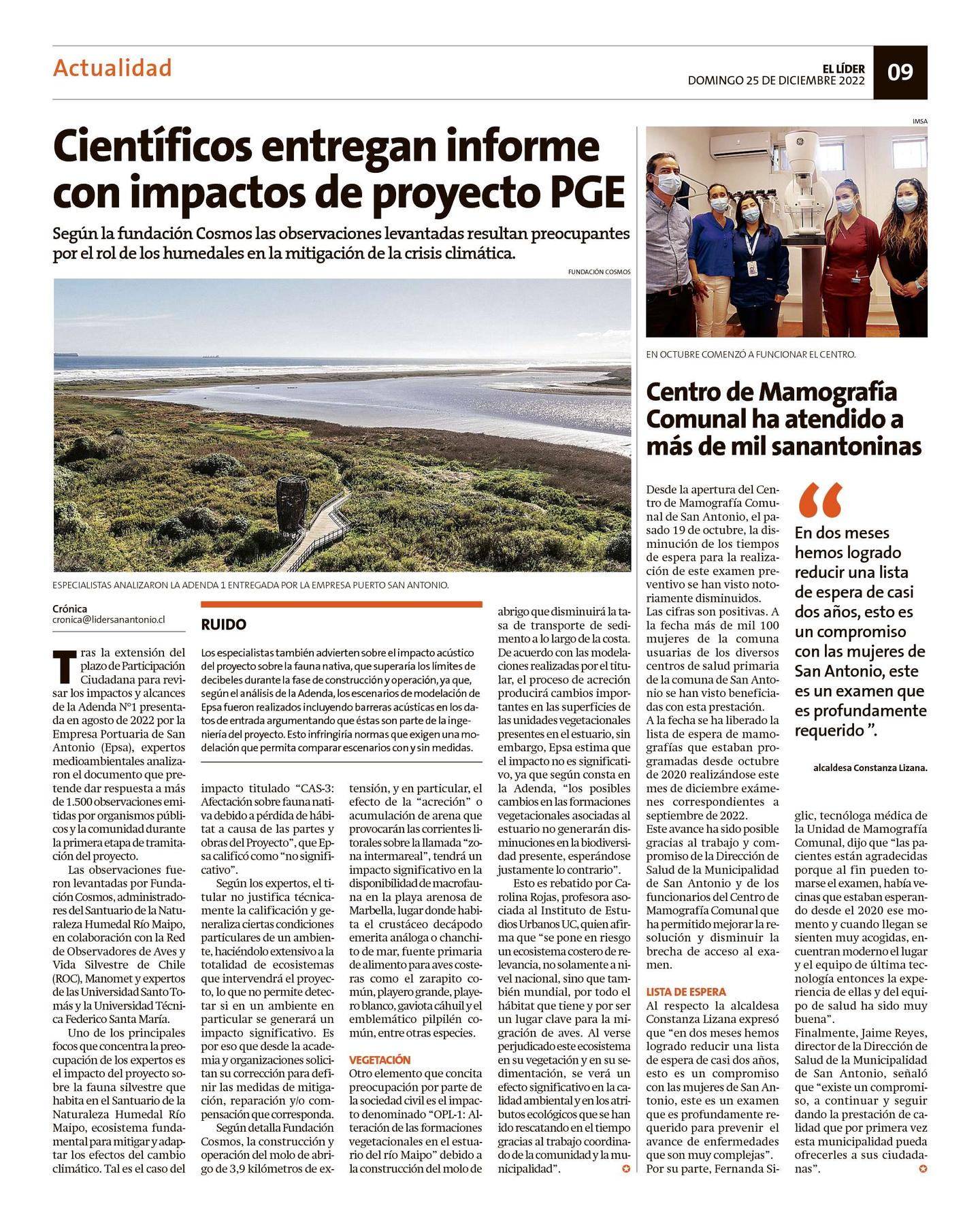
According to the Cosmos Foundation, the observations raised are worrying given the role of wetlands in mitigating the climate crisis.
Following the extension of the Citizen Participation period to review the impacts and scope of Addendum No. 1 submitted in August 2022 by the San Antonio Port Authority (EPSA), environmental experts analyzed the document, which seeks to address more than 1,500 observations issued by public agencies and the community during the first stage of the project’s processing.
The observations were collected by the Cosmos Foundation, administrators of the Maipo River Wetland Nature Sanctuary, in collaboration with the Chilean Bird and Wildlife Observers Network (ROC), Manomet, and experts from the University of Santo Tomás and the Federico Santa María Technical University.
One of the main areas of concern for experts is the project’s impact on the wildlife that inhabits the Maipo River Wetland Nature Sanctuary, a key ecosystem for mitigating and adapting to the effects of climate change. This is the case with the impact titled “CAS-3: Impact on native fauna due to habitat loss caused by the project’s components and works,” which EPSA classified as “not significant.”
According to experts, the title fails to technically justify the rating and generalizes certain specific environmental conditions, extending it to all ecosystems affected by the project. This makes it impossible to determine whether a particular environment will have a significant impact. Therefore, academia and organizations are requesting its correction in order to define the appropriate mitigation, repair, and/or compensation measures.
According to Fundación Cosmos, the construction and operation of the 3.9-kilometer breakwater, and in particular, the effect of the “accretion” or accumulation of sand that coastal currents will cause in the so-called “intertidal zone”, will have a significant impact on the availability of macrofauna on the sandy beach of Marbella, where the decapod crustacean emerita analoga or chanchito de mar lives, a primary food source for coastal birds such as the common curlew, great sandpiper, white sandpiper, gull and the emblematic common pilpilén, among other species.
VEGETATION
Another element that raises concern among civil society is the impact known as “OPL-1: Alteration of vegetation formations in the Maipo River estuary” due to the construction of the breakwater, which will reduce the rate of sediment transport along the coast. According to the modeling carried out by the landowner, the accretion process will produce significant changes in the surfaces of the vegetation units present in the estuary. However, EPSA estimates that the impact is not significant, since, as stated in the Addendum, “the possible changes in the vegetation formations associated with the estuary will not generate decreases in the existing biodiversity; precisely the opposite is expected.”
This is refuted by Carolina Rojas, associate professor at the UC Institute of Urban Studies, who states that “a coastal ecosystem of national and global importance is at risk, due to its habitat and its key role as a place for bird migration. The damage to this ecosystem’s vegetation and sedimentation will have a significant impact on environmental quality and the ecological attributes that have been restored over time thanks to the coordinated work of the community and the municipality.”