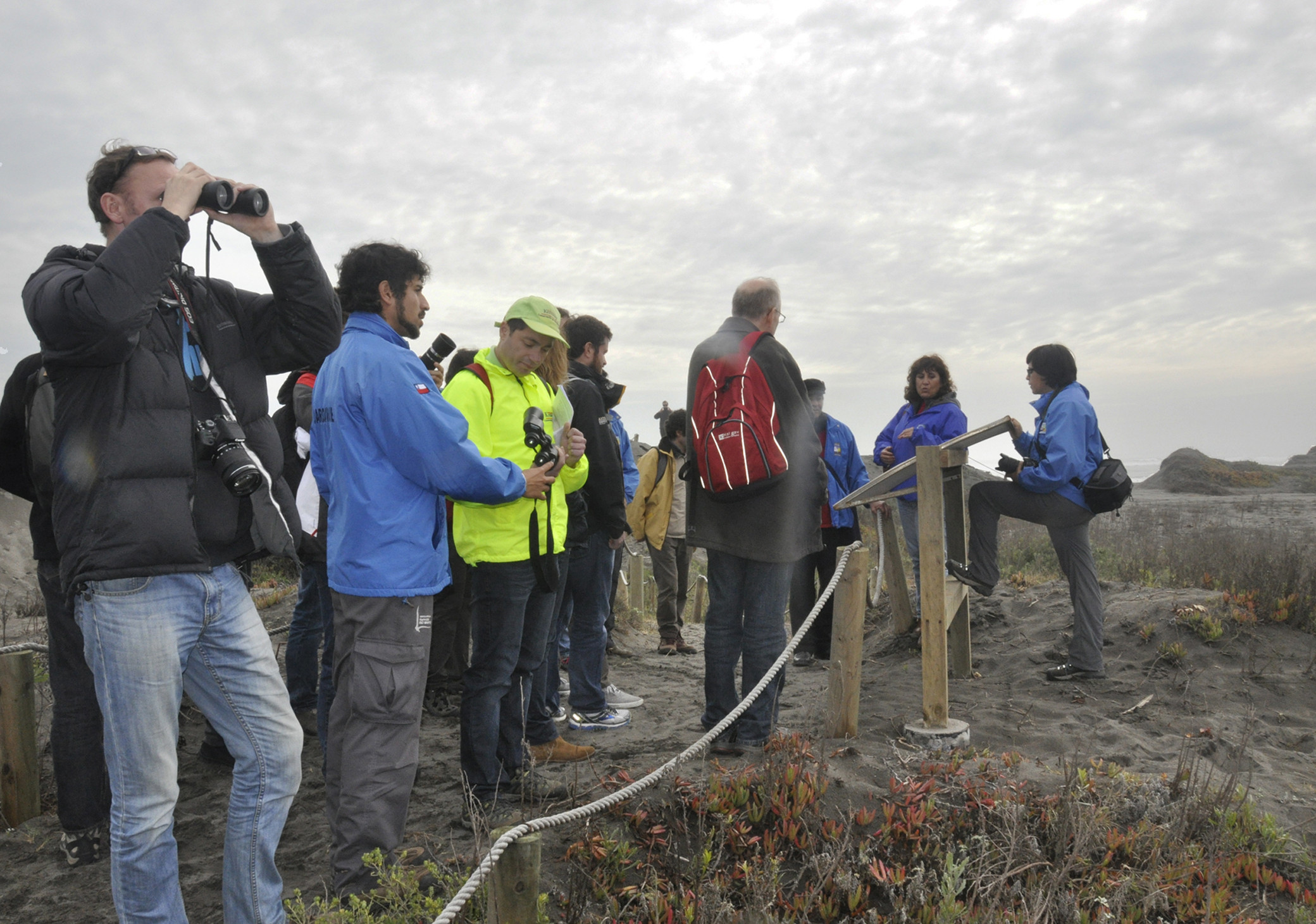
OECD delegation visits the Maipo River Wetland
- Published on 10.07.2015
- Written by Angel Fondon
As part of the Environmental Performance Assessment of Chile, which is being conducted this week by a mission from the Organization for Economic Cooperation and Development (OECD), a visit was made today to the El Yali and Río Maipo wetlands to learn about their threats and potential firsthand. These two wetlands are of great environmental importance, but their conservation and management situations are very different, making them interesting to analyze and compare.
“This visit is very important for us, as it allows us to share our interest in continuing the work and care of the Maipo River Wetland, a transcendental initiative we have carried out with the Cosmos Foundation and Mar Adentro. We feel privileged and hope that more policies will continue to be developed for the protection and conservation of our two wetlands, as their biodiversity endows them with great natural wealth,” said Santo Domingo Mayor Fernando Rodríguez Larraín.
The Maipo River coastal wetland, located between the municipalities of San Antonio and Santo Domingo, has immense biological value due primarily to the large number and diversity of marine and freshwater birds that inhabit it, 94% of which are endemic and/or native to Chile. Located within the wetland is the Maipo River Wetland Nature Park , created by the Municipality of Santo Domingo in 2003 with the aim of protecting and safeguarding the biodiversity of this area. The park covers approximately 40 hectares and, since last year, has enjoyed the support and commitment of the Cosmos and Mar Adentro Foundations to strengthen it and provide it with the infrastructure to guarantee its protection, on the one hand, and the recreation of visitors, on the other. The Maipo River Wetland is subject to the pressures and threats present in most coastal wetlands, but is still in a good state of conservation.
“In the Maipo River Wetland, we see a unique opportunity to develop a project that combines conservation with sustainable recreational, tourism, educational, and scientific use, as is desirable in an OECD country,” said Diego Urrejola, Project Director of the Cosmos Foundation.
The El Yali wetland, for its part, is located on the southern border of the Santo Domingo commune and covers an area of 11,500 hectares, within which is the El Yali National Reserve, declared a RAMSAR site in 2013 and managed by CONAF. This wetland is of recognized ecological importance due to the presence of 103 species of native and/or endemic birds in Chile, many of them with conservation issues. Furthermore, its uniqueness in archaeological and paleontological terms stands out, as does the biodiversity of vertebrates, including terrestrial and marine mammals. Unfortunately, like many coastal wetlands, El Yali is subject to severe pressures and threats of anthropogenic origin that are drying it out. These include, for example, the use of the waters that feed the wetland for crop irrigation in the vicinity, and the introduction of exotic species in the area, such as eucalyptus, which demand large quantities of water.
The environmental performance assessment being carried out by the OECD is the first conducted on Chile as a full member of the organization and covers the period 2005-2015. The process will take approximately 18 months (January 2015 to July 2016) and will also include a presentation by the country at OECD headquarters in Paris and the launch of the report and recommendations in June 2016. These assessments seek to support member countries in meeting their national and international environmental objectives by exchanging good practices, providing specific recommendations, and generally encouraging greater transparency in environmental management.