El Líder de San Antonio | Pilpilén faces a new reproductive season in the Maipo River Wetland
- Published on 01.11.2025
- Written by Angel Fondon
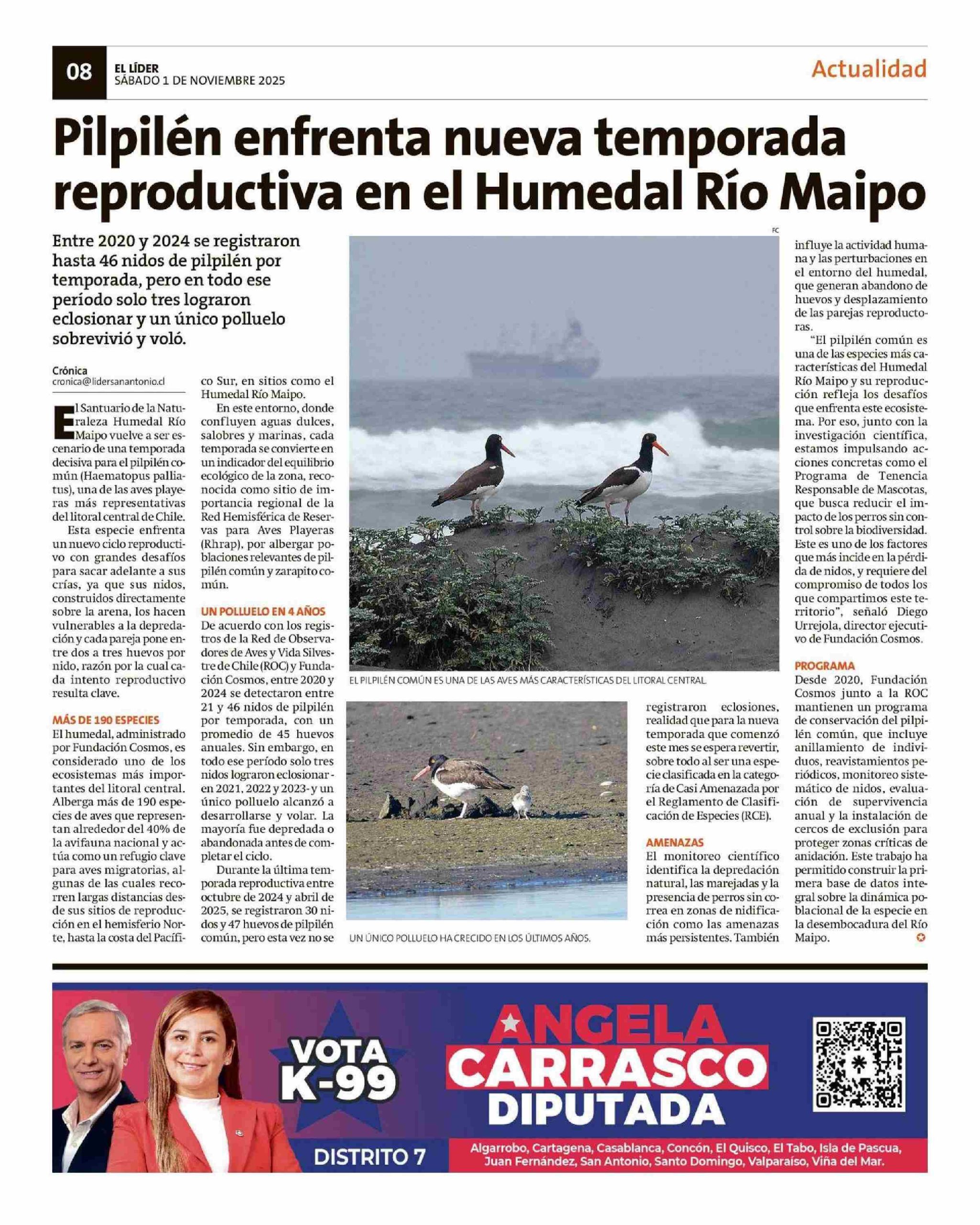
The Río Maipo Wetland Nature Sanctuary is once again the setting for a crucial season for the American oystercatcher (Haematopus palliatus), one of the most representative shorebirds of Chile’s central coast. This species faces a new reproductive cycle with significant challenges in raising its young, as its nests, built directly on the sand, make them vulnerable to predation, and each pair lays between two and three eggs per nest, making every reproductive attempt vital.
MORE THAN 190 SPECIES
The wetland, managed by Fundación Cosmos, is considered one of the most important ecosystems on the central coast. It is home to more than 190 bird species, representing approximately 40% of the national avifauna, and serves as a key refuge for migratory birds, some of which travel long distances from their breeding grounds in the Northern Hemisphere to the South Pacific coast, in places like the Río Maipo Wetland. In this environment, where fresh, brackish, and marine waters converge, each season becomes an indicator of the area’s ecological balance. It is recognized as a site of regional importance within the Western Hemisphere Shorebird Reserve Network (WHSRN) for its significant populations of American Oystercatcher and Whimbrel.
A CHICK IN 4 YEARS
According to records from the Chilean Network of Bird and Wildlife Observers (ROO) and the Cosmos Foundation, between 2020 and 2024, between 21 and 46 nests of the American Oystercatcher were detected per season, with an average of 45 eggs annually. However, during that entire period, only three nests hatched—in 2021, 2022, and 2023—and only one chick managed to develop and fledge. Most were preyed upon or abandoned before completing their life cycle. During the last breeding season, between October 2024 and April 2025, 30 nests and 47 eggs of the American Oystercatcher were recorded, but this time no hatchings were observed. This situation is expected to change for the new season that began this month, especially since the American Oystercatcher is classified as Near Threatened by the Species Classification Regulations (RCE).
THREATS
Scientific monitoring identifies natural predation, storm surges, and the presence of unleaded dogs in nesting areas as the most persistent threats. Human activity and disturbances in the wetland environment also play a role, leading to egg abandonment and displacement of breeding pairs. “The common oystercatcher is one of the most characteristic species of the Maipo River Wetland, and its reproduction reflects the challenges this ecosystem faces. That’s why, along with scientific research, we are promoting concrete actions such as the Responsible Pet Ownership Program, which seeks to reduce the impact of uncontrolled dogs on biodiversity. This is one of the factors that most significantly contributes to nest loss and requires the commitment of everyone who shares this territory,” stated Diego Urrejola, executive director of Fundación Cosmos.
PROGRAM
Since 2020, Fundación Cosmos, in partnership with ROC, has maintained a conservation program for the American Oystercatcher, which includes banding individuals, periodic resightings, systematic nest monitoring, annual survival assessments, and the installation of exclusion fences to protect critical nesting areas. This work has allowed for the creation of the first comprehensive database on the population dynamics of the species at the mouth of the Maipo River.