The Leader | Cosmos Foundation calls for measures to prevent the Maipo River from flowing into the river.
- Published on 24.01.2023
- Written by Angel Fondon
Last week, the river did not cross the bar due to low flow, caused by various factors associated with climate change.
According to data released by the Cosmos Foundation last week, the Maipo River’s flow rate reached only 1.9 cubic meters per second, well below the historical average of 94 cubic meters per second in January and the 30 cubic meters per second recorded over the past five years.
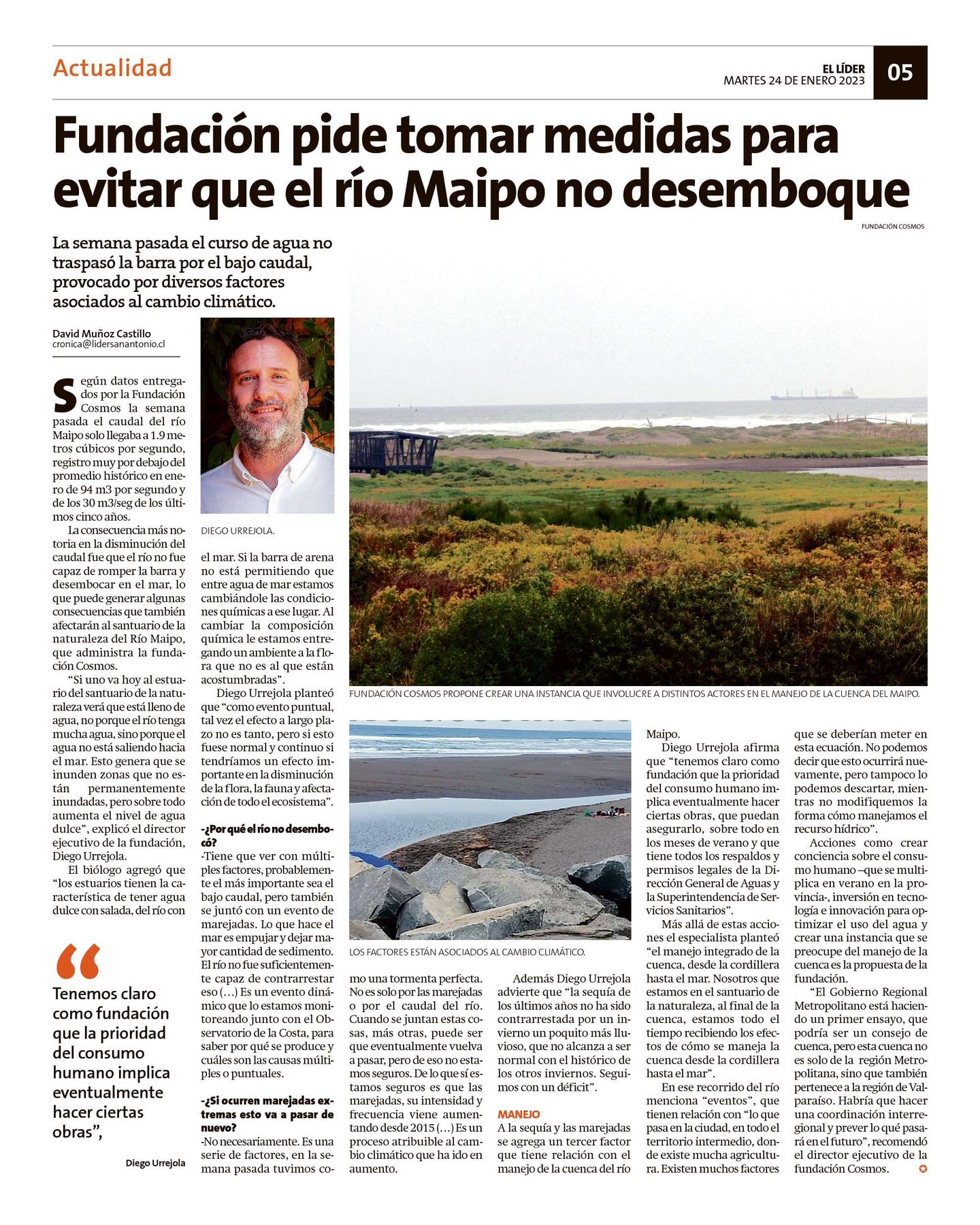
The most notable consequence of the decrease in flow was that the river was unable to break the barrier and flow into the sea, which could have consequences that will also affect the Maipo River Nature Sanctuary, managed by the Cosmos Foundation.
“If you go to the nature sanctuary’s estuary today, you’ll see that it’s full of water, not because the river has a lot of water, but because the water isn’t flowing out to sea. This causes flooding in areas that aren’t permanently flooded, but above all, it increases the level of freshwater,” explained the foundation’s executive director, Diego Urrejola.
The biologist added that “estuaries have the characteristic of having freshwater with saltwater, from the river with the sea. If the sandbar is not allowing seawater to enter, we are changing the chemical conditions of that place. By changing the chemical composition, we are providing the flora with an environment that is not what they are used to.”
Diego Urrejola stated that “as a one-time event, the long-term impact may not be significant, but if this were normal and ongoing, we would have a significant impact on the decline of flora and fauna and the entire ecosystem.”
-Why didn’t the river flow into the river?
-It has to do with multiple factors, probably the most important being the low flow, but it also came together with a storm surge event. What the sea does is push and leave greater amounts of sediment. The river wasn’t sufficiently capable of counteracting that (…) It’s a dynamic event that we’re monitoring together with the Coastal Observatory, to find out why it occurs and what the multiple or specific causes are.
-If extreme storm surges occur, will this happen again?
-Not necessarily. It’s a series of factors. Last week we had a kind of perfect storm. It’s not just the storm surges or the river flow. When these things come together, plus others, it could happen again eventually, but we’re not sure of that. What we are sure of is that the storm surges, their intensity and frequency, have been increasing since 2015 (…) It’s a process attributable to climate change, which has been increasing.
Furthermore, Diego Urrejola warns that “the drought of recent years has not been offset by a slightly wetter winter, which is not comparable to the historical record of previous winters. We continue to have a deficit.”
Management
In addition to drought and storm surges, a third factor is related to the management of the Maipo River basin.
Diego Urrejola states that “as a foundation, we are clear that prioritizing human consumption eventually requires carrying out certain projects that can guarantee this, especially during the summer months, and that have all the legal support and permits from the General Directorate of Water and the Superintendency of Sanitary Services.”
Beyond these actions, the specialist proposed “integrated management of the watershed, from the mountains to the sea. We, who are in the nature sanctuary, at the end of the watershed, are constantly experiencing the effects of how the watershed is managed from the mountains to the sea.”
In this river course, he mentions “events” that are related to “what happens in the city, in the entire intervening territory, where there is a lot of agriculture. There are many factors that should be factored into this equation. We can’t say this will happen again, but we can’t rule it out either, as long as we don’t change the way we manage water resources.”
The foundation’s proposal includes actions such as raising awareness about human consumption—which increases significantly in the province during the summer—investing in technology and innovation to optimize water use, and creating a body responsible for managing the watershed.
“The Metropolitan Regional Government is conducting a first trial, which could be a basin council, but this basin is not only part of the Metropolitan Region; it also belongs to the Valparaíso region. Interregional coordination is necessary, and we should anticipate what will happen in the future,” recommended the executive director of the Cosmos Foundation.