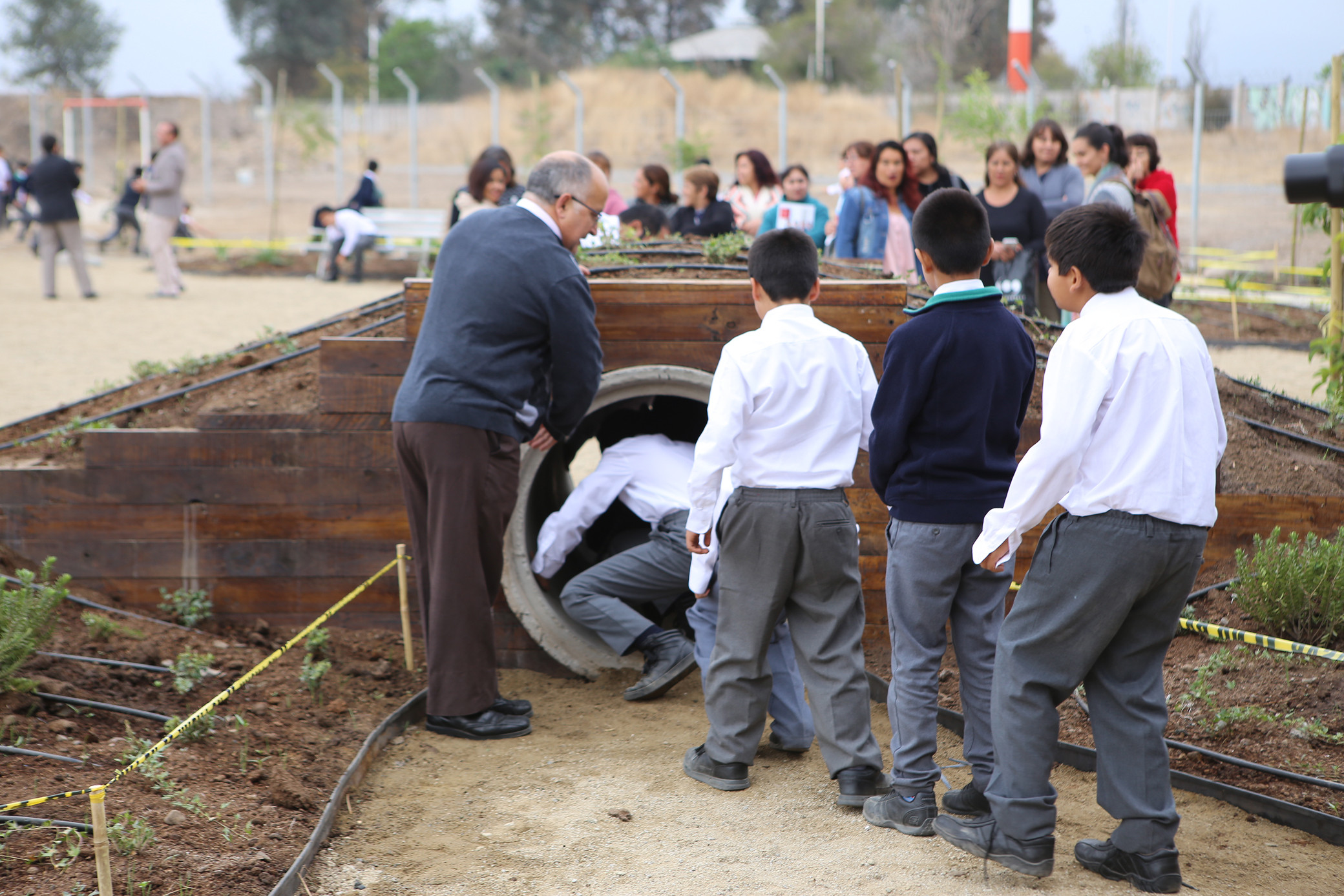
The first outdoor playground opens at PuenteMaipo School.
- Publicado el 24.03.2017
- Escrito por Angel Fondon
Last Friday, the first green play and recreation area was inaugurated at PuenteMaipo School, located in the Bajos de Mena neighborhood of the Puente Alto commune. It is a space specifically designed for children to play and interact with nature, reaping the benefits that this brings.
PuenteMaipo School is a project of the Nocedal Foundation—a non-profit educational institution that provides excellent education to children and young people from vulnerable sectors—and was inaugurated in 2014 with the aim of serving 850 children and young people from Bajos de Mena. It currently has 350 students and a built-up area of approximately 3,000 square meters, which will be complemented with various green areas. One of these is this first courtyard, developed through a collaborative partnership between the Nocedal Foundation, the Cosmos Foundation, and PuenteMaipo School.
“We are very pleased to be able to provide the children with a playground where they can play and connect with nature, which—as we know—brings multiple psychological and physical benefits. We thank the Nocedal Foundation for extending this invitation, and we look forward to continuing to work together,” said Francisco Croxatto, architect at the Cosmos Foundation.
This playground is part of the PuenteMaipo School’s Green Area Master Plan, which the Cosmos Foundation is designing to facilitate the entire school community’s connection with nature. It will include the creation of outdoor play areas; shaded areas for sitting, resting, or eating; green areas outside the school; barbecue areas for weekend use; and spacious family areas. In this way, the green areas of PuenteMaipo School will be a green lung for the community and a vitally important space for students, their families, and staff to gather.
Bajos de Mena is home to approximately 120,000 people, occupying a surface area of just 600 hectares. It is a highly complex area given its high population density, limited access to basic services, and limited coverage of quality green areas for recreation and community coexistence.
It’s worth noting that green spaces are key elements for maintaining a good quality of life in cities and promoting people’s well-being. Contact with nature helps reduce stress; it encourages recreation, reflection, and a sense of freedom. Furthermore, they can be optimal spaces for developing environmental education projects, allowing children and adults to integrate new knowledge about the biodiversity of a given location, generating greater appreciation and awareness of our environment.