
Little Cottolengo inaugurates therapeutic garden
- Publicado el 08.03.2016
- Escrito por Angel Fondon
This morning, the first therapeutic garden for children and adults with severe neurological damage was inaugurated at the Little Cottolengo. This is the “Peace and Love” garden located inside the pavilion of the same name, where 45 patients with limited or no mobility live. They were unable to get out on their own to enjoy the interior garden of this pavilion, much less other green areas of the Cottolengo.
To reverse this situation, three foundations, along with the beneficiary institution itself, proposed building a universally accessible therapeutic garden so that all patients could go out and connect with nature and benefit from it.
“It’s wonderful to see how the people who work at this home and our residents, most of whom are bedridden, are enjoying their contact with nature. Interacting with and contemplating it has created a warm atmosphere of well-being,” said Father Claudio Chávez, priest of the Pequeño Cottolengo in Santiago.
The new “Peace and Love” garden is a therapeutic space divided into two areas—one interactive and the other contemplative—connected by an enclosed terrace with large windows so patients can enjoy nature even when the weather doesn’t allow them to go outside. Therapeutic gardens have elements to stimulate the senses of their users, and infrastructure to interact with nature, such as wheelchair-accessible gardening tables and grassy rest areas. This allows residents to develop physical skills and explore their sensations, as well as increasing self-confidence, a sense of freedom, and satisfaction. And most importantly, these gardens have universal access suitable for patients who live in a state of bedridden, in wheelchairs, and on stretchers. “The idea is that everyone can now go out and connect with nature and benefit from its colors, aromas, sounds, and shapes. We hope that examples like this continue to be replicated more and more in Chile,” said Felipe Correa, architect at the Cosmos Foundation.
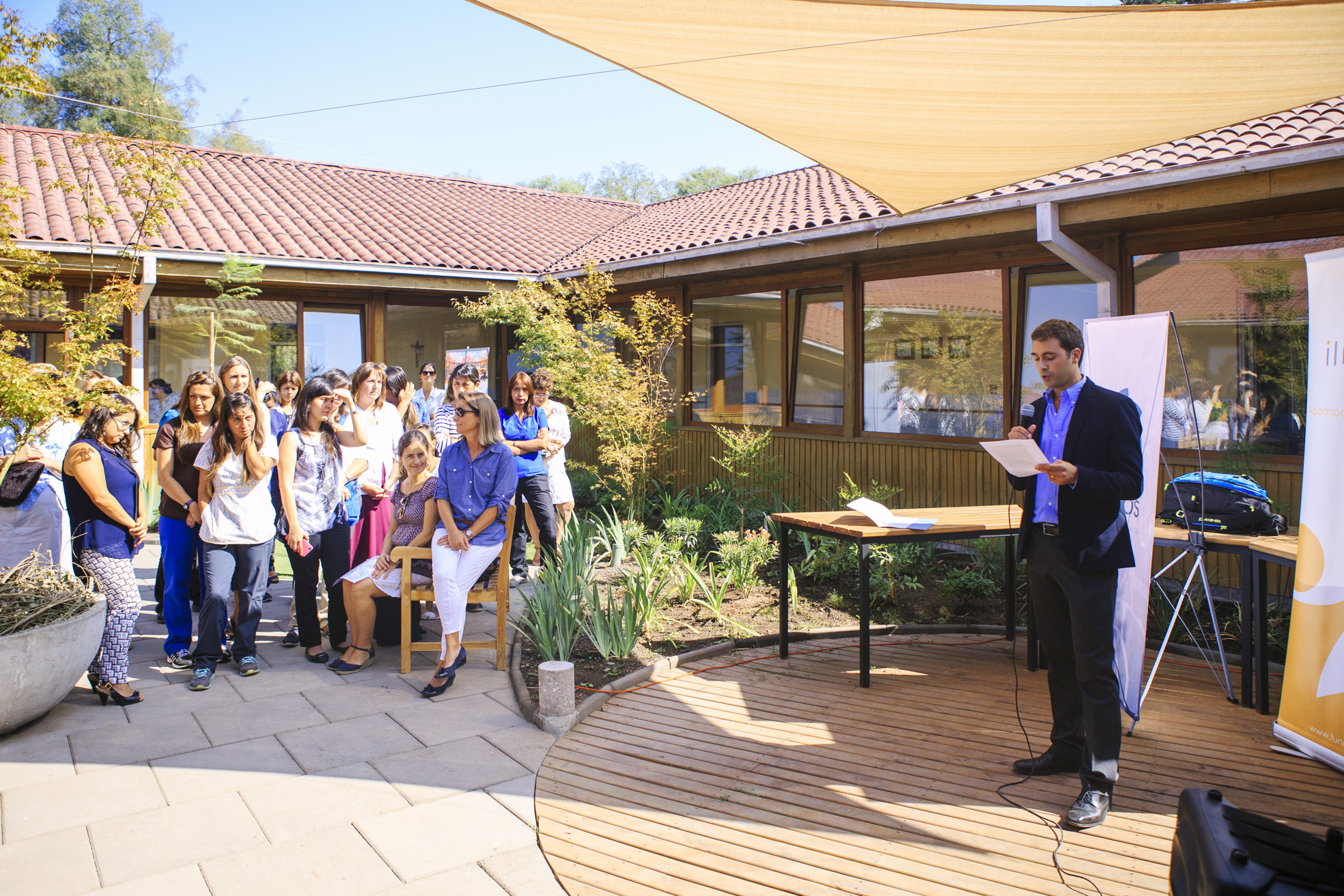
It should be noted that the design of the Peace and Love Garden was based on the needs and desires expressed by the site’s own staff, as well as a clinical diagnosis developed by the Catholic University’s School of Psychology, also following international guidelines for the design of this type of garden.
“We are very happy to finally see how the concerns and dreams we gathered from those who work here have been reflected in this garden, which not only alleviates the daily lives of the patients, but also of the Cottolengo staff,” said Doris Erlwein, executive director of the Inspira Foundation.
“Although the development of healing and therapeutic gardens is still in its infancy in Chile, cases like that of the Little Cottolengo help demonstrate what is possible to naturalize environments and improve the quality of life of people with physical or mental illnesses who are in dire need,” said Sonia Cox, executive director of the Ilumina Foundation.
It has been proven that exposure to green spaces is beneficial for people’s mental and physical health and contributes significantly to patient rehabilitation. More and more scientific studies demonstrate this, and therefore, the development of healing and therapeutic gardens in medical facilities is a growing trend worldwide.
Europe, the United States, and Canada are global leaders in this trend, and are the places where the positive effects of gardens and vegetation on people’s mental health have been most studied. In the 1980s, Swedish doctor Roger Ulrich—one of the most prominent in this field and co-founder of the Center for Health Systems and Design at Texas A&M University—published the study “View through a window, may influence recovery from surgery,” in which he points out that “looking at a garden can speed recovery from surgery, infections, or other ailments.” Meanwhile, neuroimmunologist Esther Sternberg agrees in her book, “Healing Spaces: The Science of Place and Well-Being,” that just three to five minutes of observing spaces dominated by trees, flowers, or water helps reduce anger, anxiety, and pain, and also induces relaxation and changes in blood pressure, muscle tension, and electrical activity of the heart and brain.