El Mercurio | The Maipo River does not flow into the sea, something unprecedented since records began.
- Publicado el 26.01.2023
- Escrito por Angel Fondon
Experts point to intensive extraction throughout the entire river basin amid the megadrought. Authorities inspected the estuary area yesterday.
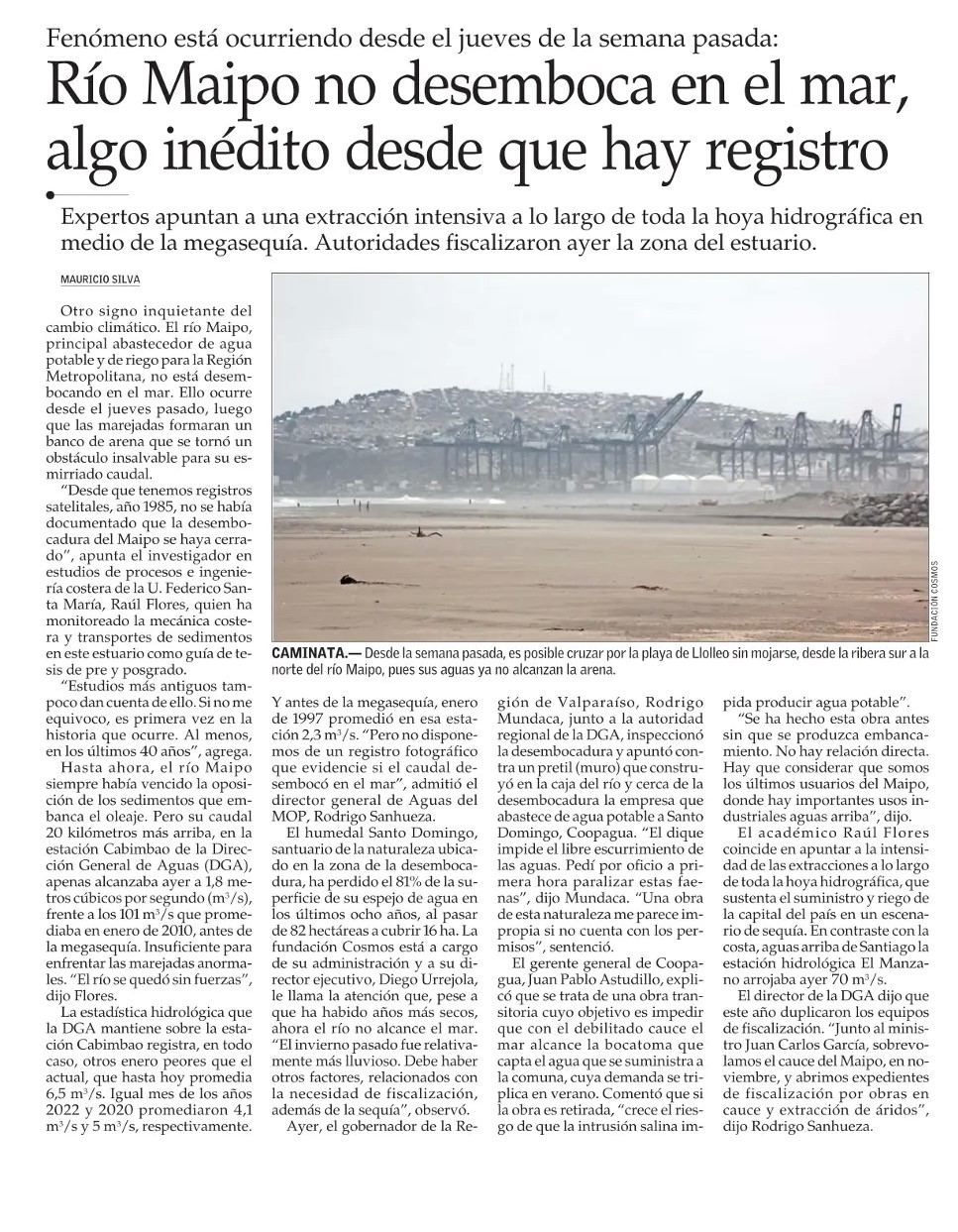
Another disturbing sign of climate change. The Maipo River, the main supplier of drinking and irrigation water for the Metropolitan Region, is no longer flowing into the sea. This has been happening since last Thursday, after storm surges formed a sandbar that became an insurmountable obstacle to its meager flow.
“Since we have satellite records, in 1985, there has been no documented closure of the Maipo estuary,” notes Raúl Flores, a researcher in coastal process studies and engineering at Federico Santa María University. He has monitored coastal mechanics and sediment transport in this estuary as a guide for undergraduate and graduate theses.
“Older studies don’t account for this either. If I’m not mistaken, this is the first time in history that this has happened. At least in the last 40 years,” he adds.
Until now, the Maipo River had always overcome the resistance of the sediments that build up the waves. But its flow 20 kilometers upstream, at the Cabimbao station of the General Directorate of Water (DGA), yesterday barely reached 1.8 cubic meters per second (m3/s), compared to the 101 m3/s it averaged in January 2010, before the megadrought. This was insufficient to withstand the abnormal surges. “The river has run out of strength,” said Flores.
The hydrological statistics maintained by the DGA on the Cabimbao station, however, show other Januarys worse than the current one, which to date averages 6.5 m3/s. The same months in 2022 and 2020 averaged 4.1 m3/s and 5 m3/s, respectively. And before the megadrought, January 1997 averaged 2.3 m3/s at that station. “But we don’t have photographic records to show whether the flow flowed into the sea,” admitted Rodrigo Sanhueza, Director General of Water at the Ministry of Public Works.
The Santo Domingo Wetland, a nature sanctuary located near the river mouth, has lost 81% of its water surface area in the last eight years, going from 82 hectares to 16 hectares. The Cosmos Foundation is in charge of its administration, and its executive director, Diego Urrejola, is concerned that, despite drier years, the river is currently not reaching the sea. “Last winter was relatively wetter. There must be other factors related to the need for monitoring, besides the drought,” he observed.
Yesterday, the governor of the Valparaíso Region, Rodrigo Mundaca, along with the regional authority of the DGA (General Directorate of Agriculture), inspected the river mouth and pointed to a dam (wall) built in the river bed near the mouth by the company that supplies drinking water to Santo Domingo, Coopagua. “The dam impedes the free flow of water. I officially requested this work to be halted early in the morning,” Mundaca said. “I consider a project of this nature inappropriate if it doesn’t have the necessary permits.”
Coopagua’s general manager, Juan Pablo Astudillo, explained that this is a temporary project aimed at preventing the weakened riverbed from reaching the intake that collects water for the community, whose demand triples in the summer. He commented that if the project is removed, “the risk of saline intrusion preventing the production of drinking water increases.”
“This work has been done before without causing silting. There’s no direct relationship. We have to consider that we’re the last users of the Maipo River, where there are significant industrial uses upstream,” he said.
Academician Raúl Flores agrees, pointing to the intensity of extractions throughout the entire hydrographic basin, which supports the supply and irrigation of the nation’s capital in a drought scenario. In contrast to the coast, upstream from Santiago, the El Manzano hydrological station yesterday yielded 70 m3/s.
The director of the DGA said they doubled the number of inspection teams this year. “Together with Minister Juan Carlos García, we flew over the Maipo River in November and opened inspection files for channel works and aggregate extraction,” said Rodrigo Sanhueza.