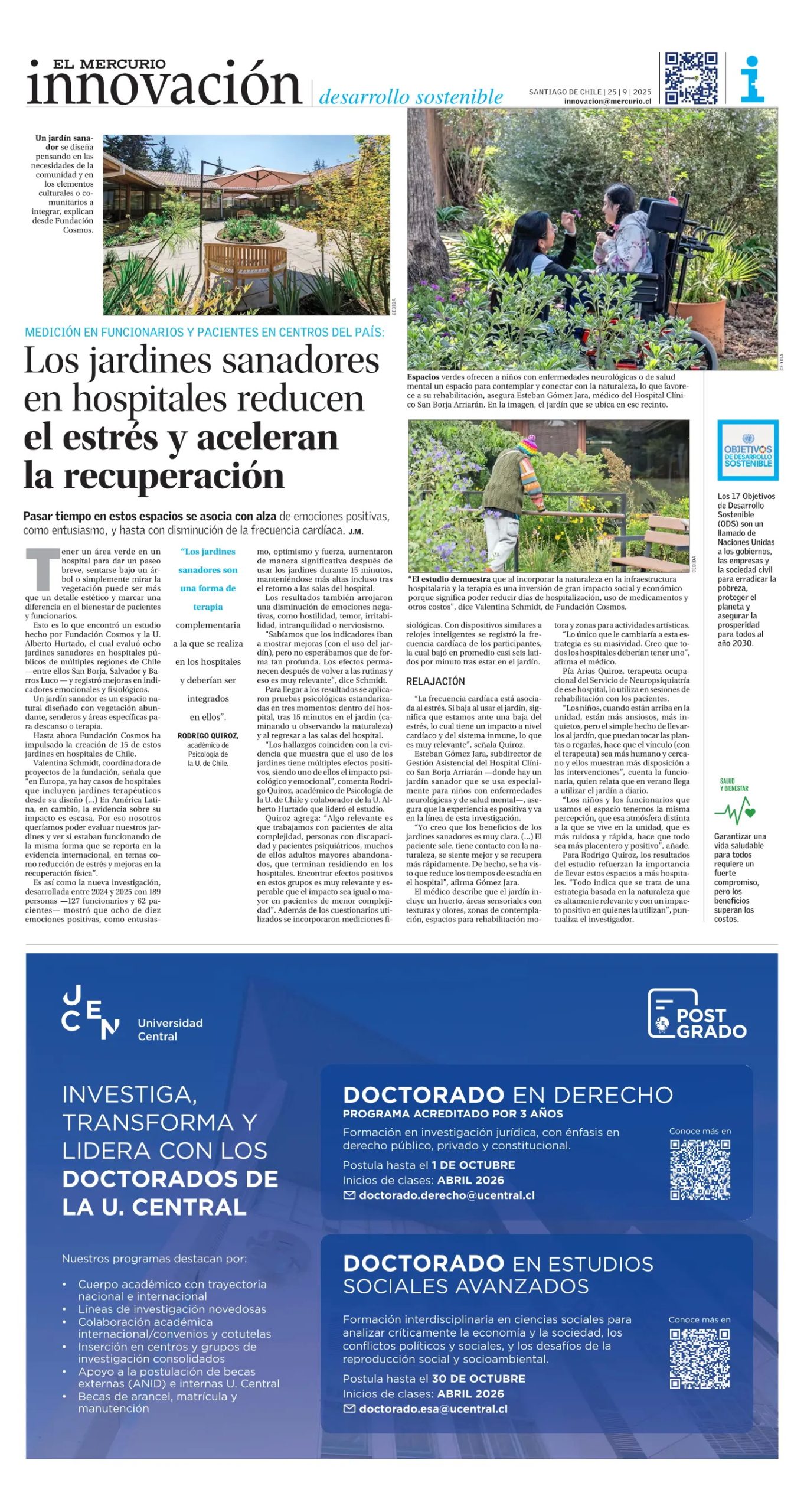
El Mercurio || Healing gardens in hospitals reduce stress and speed recovery
- Publicado el 25.09.2025
- Escrito por Angel Fondon
Spending time in these spaces is associated with increased positive emotions, such as enthusiasm, and even a decreased heart rate.
Having a green area in a hospital for a short walk, sitting under a tree, or simply gazing at the vegetation can be more than just an aesthetic detail and can make a difference in the well-being of patients and staff.
This is the finding of a study conducted by the Cosmos Foundation and Alberto Hurtado University, which evaluated eight healing gardens in public hospitals in multiple regions of Chile—including San Borja, Salvador, and Barros Luco—and recorded improvements in emotional and physiological indicators.
A healing garden is a natural space designed with abundant vegetation, paths, and specific areas for rest or therapy.
To date, the Cosmos Foundation has promoted the creation of 15 of these gardens in Chilean hospitals.
Valentina Schmidt, the foundation’s project coordinator, points out that “in Europe, there are already cases of hospitals that include therapeutic gardens from their design (…) In Latin America, on the other hand, evidence of their impact is scarce. That’s why we wanted to be able to evaluate our gardens and see if they were working in the same way as reported in international evidence, in areas such as stress reduction and improvements in physical recovery.”
This is how the new research, carried out between 2024 and 2025 with 189 people—127 staff members and 62 patients—showed that eight out of ten positive emotions, such as enthusiasm, optimism, and strength, increased significantly after using the gardens for 15 minutes, remaining higher even after returning to the hospital wards.
The results also showed a decrease in negative emotions, such as hostility, fear, irritability, restlessness, and nervousness.
“We knew the indicators would show improvements (with the use of the garden), but we didn’t expect them to be so profound. The effects persist after returning to routines, and that’s very significant,” says Schmidt.
To arrive at the results, standardized psychological tests were administered at three points: inside the hospital, after 15 minutes in the garden (walking or observing nature), and upon returning to the hospital wards.
“The findings are consistent with evidence showing that garden use has multiple positive effects, one of which is its psychological and emotional impact,” says Rodrigo Quiroz, a psychology professor at the University of Chile and a collaborator at Alberto Hurtado University who led the study.
Quiroz adds: “Something relevant is that we work with highly complex patients, people with disabilities, and psychiatric patients, many of them abandoned elderly adults, who end up residing in hospitals. Finding positive effects in these groups is highly relevant, and we expect the impact to be equal or greater in less complex patients.” In addition to the questionnaires used, physiological measurements were incorporated. Participants’ heart rates were recorded using devices similar to smartwatches, dropping an average of almost six beats per minute after being in the garden.
Relaxation
“Heart rate is associated with stress. If it drops when using the garden, it means a decrease in stress, which has a very significant impact on the heart and immune system,” Quiroz points out.
Esteban Gómez Jara, deputy director of Healthcare Management at the San Borja Arriarán Clinical Hospital—where there is a healing garden specifically for children with neurological and mental health conditions—asserts that the experience is positive and in line with this research.
“I believe the benefits of healing gardens are very clear. (…) The patient gets out, has contact with nature, feels better, and recovers more quickly. In fact, it has been shown to reduce hospital stays,” says Gómez Jara.
The doctor describes the garden as including a vegetable garden, sensory areas with textures and scents, contemplation areas, spaces for motor rehabilitation, and areas for artistic activities.
“The only thing I would change about this strategy is its massiveness. I think every hospital should have one,” the doctor says.
Pía Arias Quiroz, an occupational therapist at the hospital’s Neuropsychiatry Department, uses it in rehabilitation sessions with patients.
‘Children, when they’re upstairs in the unit, are more anxious, more restless, but the simple act of taking them to the garden, allowing them to touch the plants or water them, makes the bond (with the therapist) more human and intimate, and they’re more open to interventions,’ says the staff member, who reports that she uses the garden daily in the summer.
“The children and staff who use the space have the same perception: the different atmosphere from the one in the unit, which is louder and faster-paced, makes everything more pleasant and positive,” he adds.
For Rodrigo Quiroz, the study’s results reinforce the importance of bringing these spaces to more hospitals. “Everything indicates that this is a highly relevant, nature-based strategy with a positive impact on those who use it,” the researcher points out.