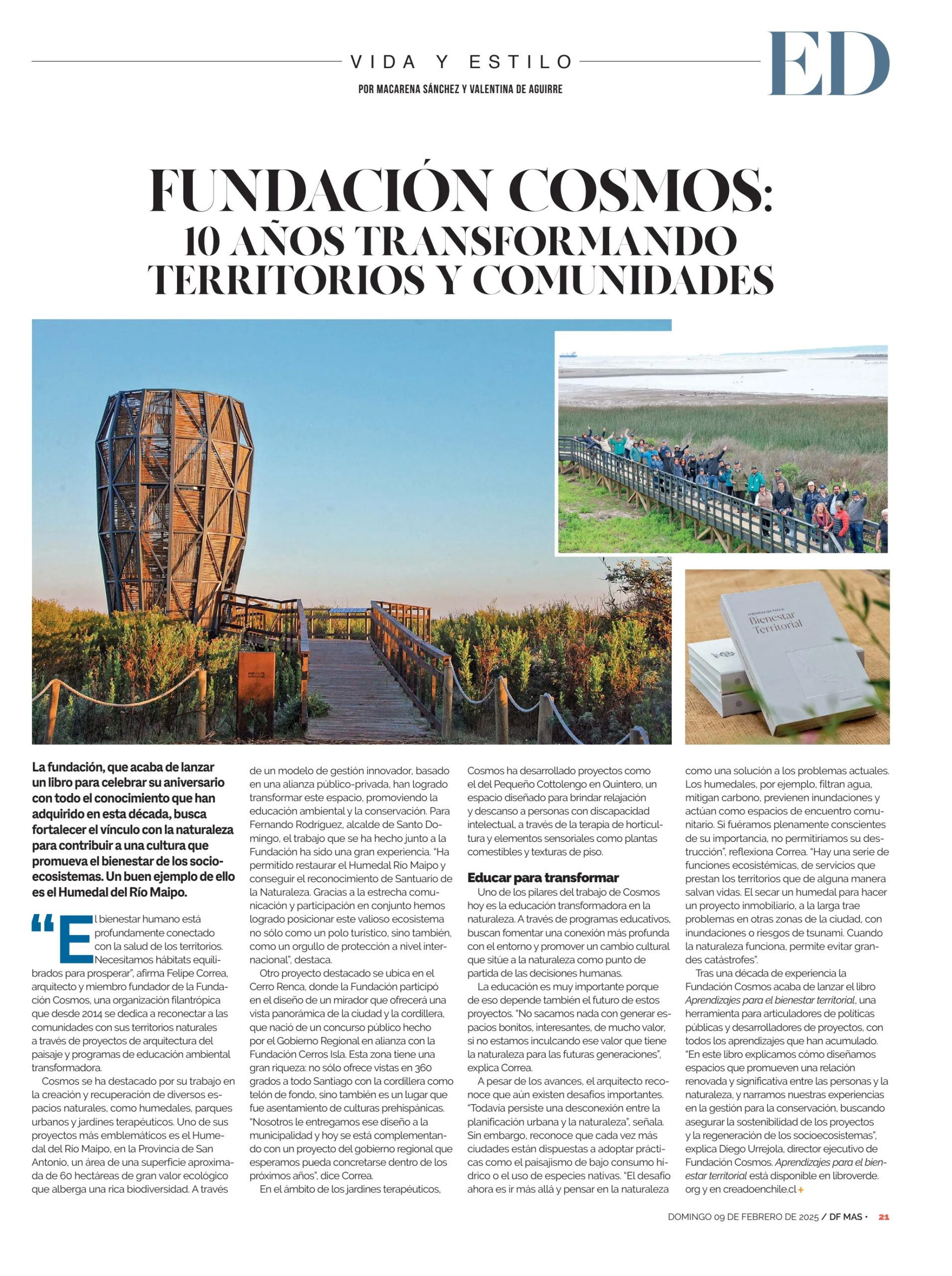
ED Magazine || Cosmos Foundation: 10 years transforming territories and communities
- Publicado el 09.02.2025
- Escrito por Angel Fondon
The foundation, which has just released a book to celebrate its anniversary featuring all the knowledge it has acquired over this decade, seeks to strengthen the connection with nature to contribute to a culture that promotes the well-being of socio-ecosystems. A good example of this is the Maipo River Wetland.
Human well-being is deeply connected to the health of territories.
‘We need balanced habitats to thrive,’ says Felipe Correa, architect and founding member of the Cosmos Foundation, a philanthropic organization that since 2014 has been dedicated to reconnecting communities with their natural territories through landscape architecture projects and transformative environmental education programs.
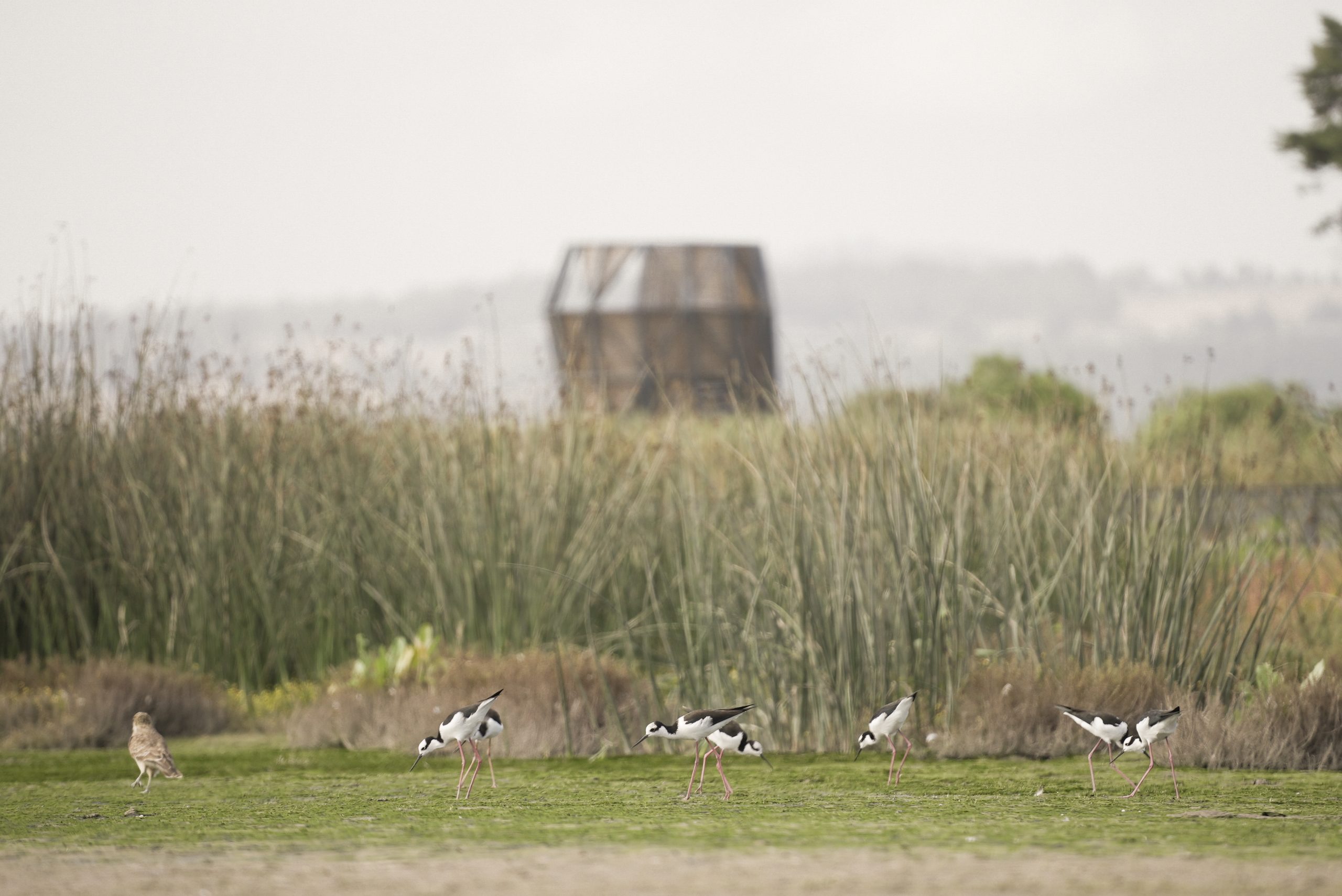
Cosmos has distinguished itself for its work in the creation and restoration of diverse natural spaces, such as wetlands, urban parks, and therapeutic gardens. One of its most emblematic projects is the Maipo River Wetland in the province of San Antonio, an area of approximately 60 hectares of great ecological value that is home to a rich biodiversity. Through an innovative management model based on a public-private partnership, they have managed to transform this space, promoting environmental education and conservation. For Fernando Rodríguez, mayor of Santo Domingo, the work carried out with the Foundation has been a great experience. “It has allowed us to restore the Maipo River Wetland and achieve recognition as a Nature Sanctuary. Thanks to close communication and joint participation, we have managed to position this valuable ecosystem not only as a tourist attraction but also as a source of pride for protection internationally,” he emphasizes.
Another notable project is located on Cerro Renca, where the Foundation participated in the design of a lookout point offering panoramic views of the city and the mountain range. This project was created through a public competition held by the Regional Government in partnership with the Cerros Isla Foundation. This area is incredibly valuable: not only does it offer 360-degree views of all of Santiago with the mountain range as a backdrop, but it is also a site that was once a settlement for pre-Hispanic cultures. “We submitted that design to the municipality, and today it is being complemented by a regional government project that we hope will be implemented within the next few years,” says Correa.
In the field of therapeutic gardens.
Cosmos has developed projects such as the Little Cottolengo in Quintero, a space designed to provide relaxation and rest for people with intellectual disabilities through horticulture therapy and sensory elements such as edible plants and floor textures.
Educate to transform
One of the pillars of Cosmos’ work today is transformative nature education. Through educational programs, they seek to foster a deeper connection with the environment and promote a cultural shift that places nature as the starting point for human decisions.
Education is very important because the future of these projects also depends on it. “We’ll gain nothing by creating beautiful, interesting, and valuable spaces if we’re not instilling the value of nature in future generations,” Correa explains.
Despite the progress, the architect acknowledges that significant challenges remain. “There is still a disconnect between urban planning and nature,” he notes. However, he recognizes that more and more cities are willing to adopt practices such as low-water landscaping or the use of native species. “The challenge now is to go further and think about nature.”
as a solution to current problems. Wetlands, for example, filter water, mitigate carbon, prevent flooding, and act as community gathering spaces. If we were fully aware of their importance, we wouldn’t allow their destruction,’ Correa reflects. ‘There are a series of ecosystem functions, services provided by territories that in some way save lives. Draining a wetland to build a real estate project eventually brings problems to other areas of the city, with flooding or tsunami risks. When nature works, it helps avoid major catastrophes.’

After a decade of experience, the Cosmos Foundation has just launched the book “Learning for Territorial Well-being,” a tool for public policy makers and project developers, incorporating all the lessons they have learned. “In this book, we explain how we design spaces that promote a renewed and meaningful relationship between people and nature, and we narrate our experiences in conservation management, seeking to ensure the sustainability of projects and the regeneration of socio-ecosystems,” explains Diego Urrejola, Executive Director of the Cosmos Foundation. “Learning for Territorial Well-being” is available at libroverde.org and creadoenchile.cl.